


Nothing in this article is a recommendation to transact in any financial product what-so-ever. The author of this article holds a ‘long’ position and stands to benefit if share prices rise of the company discussed here-in.
Please read our terms of service.
One of the best investments you can make is in a business which is selling below historical multiples with no fundamental change in their balance sheet, and business operations all while it continues to return capital to shareholders and expand.
We believe CME Group Inc. (NASDAQ: CME 0.00%↑) presents a very attractive investment opportunity. It is a strong institutional business with record revenue, strong free cash flow, a healthy balance sheet, and a powerful exchange network.
CME is ‘the’ futures exchange.
Their equity index futures are the ones referenced on financial talk shows and checked by investors on Sunday nights. CME also offers markets on interest rates, foreign exchange, energy, agriculture, metals, and crypto.
Substack doesn’t allow free subscribers to utilize the AI Detection feature, we offer a screenshot and our AI Policy for your convenience.

The Spring Selloff
CME shares started to come under intense selling pressure in May after a fever dream of leadership changes combined with Kalshi announcing they would begin offering perpetual futures.
CME’s core business is traditional futures, which come with fixed expiration dates, roll mechanics, and settlement conventions.
Perpetual ‘Perps’ futures, by contrast, are a novel instrument popularized by crypto traders. Perps provide continuous long or short exposure without a stated expiration date, and positions stay open until the trader closes them or is liquidated.
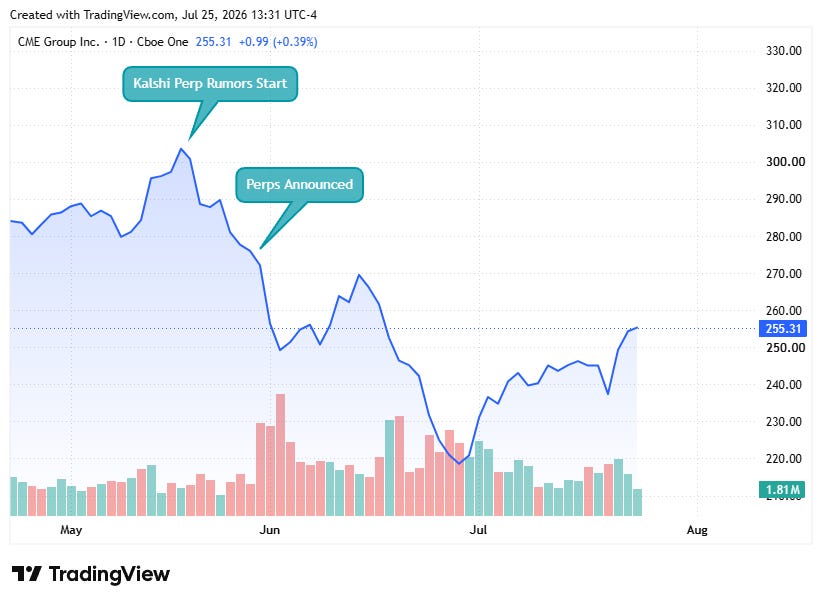
The market treated this announcement as a threat to CME’s moat. The stock now trades at at approximately 21.7x trailing earnings against their 12-month average of 25.1x well below it’s 3 and 5 year multiples, respectively.
Since the early-2020s, U.S. traders interested in perpetual futures had to go offshore, and in many cases use VPNs or other workarounds to bypass Know Your Customer (KYC) mechanics. If we view this holistically the underlying demand for perps was already out there; Kalshi’s launch simply allowed the demand to remain onshore.
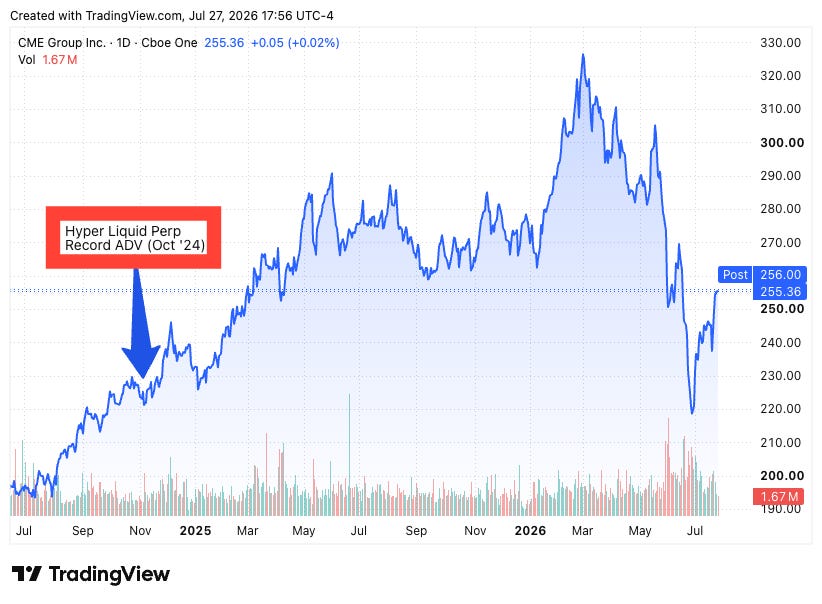
The launch did not create a whole new TAM, but simply allowed the trading volume to remain inside the U.S. This matters greatly, because if perps were truly a major threat to CME’s business model, the damage would have likely shown up earlier in the stock’s share price.
As such,
We believe the threat to CME’s core business to be vastly overestimated and misunderstood by the market; and our argument is backed by the fact that CME is continuing to produce near-record volume even after the launch of perps.
Kalshi proved there is retail demand for U.S.-regulated perps, this demand has existed for years and does not mean CME’s main business is at the risk reflected in the share price.
CME’s own Q2 remarks stated 94% of first-half 2026 volume came from institutional customers. As stated above Perps are primarily a retail oriented product and are simply not appealing to institutional traders.
Perps are highly leveraged, volatile, and have delicate funding mechanisms with significant liquidation risk which are not appealing to the risk appetite of institutional traders.
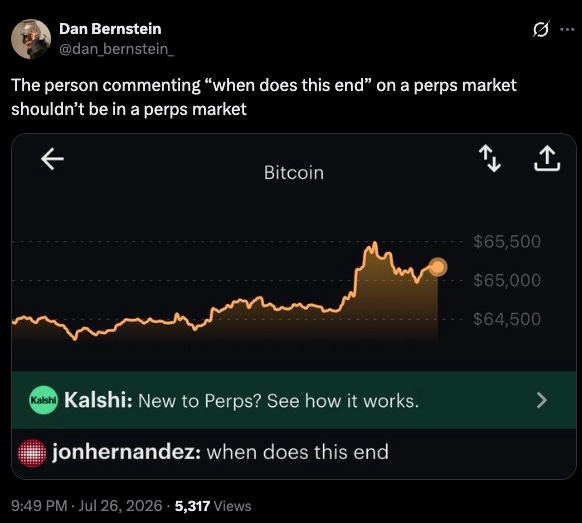
courtesy of: @dan_bernstein_
The question is whether the fundamentals moved with the multiple. The Q2 print says they did not.
CME-Q2-2026 Breakdown
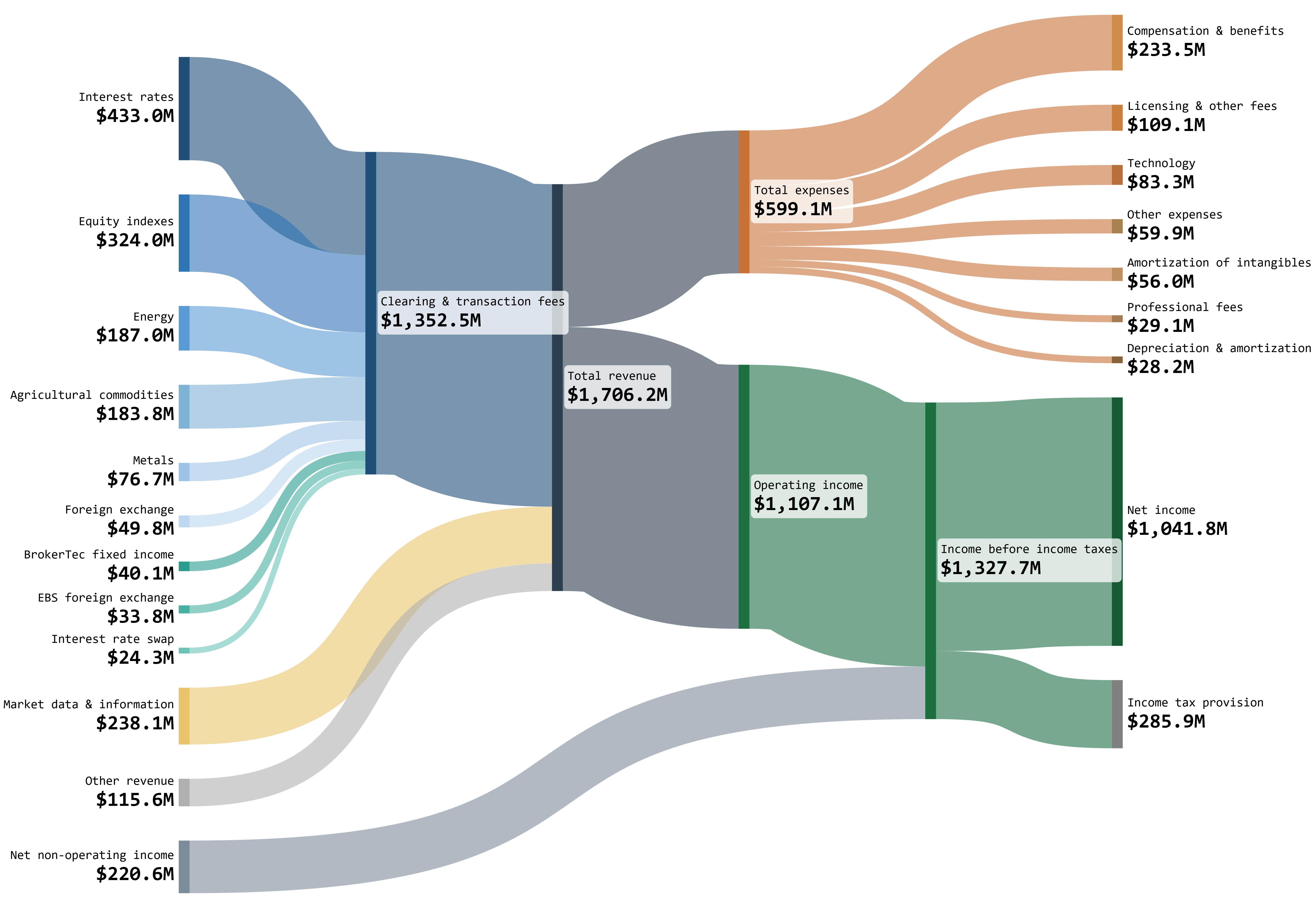
Revenue: $1.706.2B, +1% YoY
Adjusted EPS: $2.99, +1% YoY
Market data revenue: $238M, +20% YoY
ADV: 29.8M contracts, within 1% of record Q2 last year.
Open interest: +8% YoY.
