


Given the reputation of California’s complex bureaucratic systems it shouldn’t be a shock that wait times in California emergency departments are some of the longest in the country, with a statewide median ER wait time at 3 hours and 6 minutes. But that’s just the average some hospitals have had patients experience waits as long as 5 to 6 hours; and much longer in more nuanced cases.
In a modern medical context — avoidable pain and suffering left untreated (especially when the means to treat are for the most part readily available.) is an egregious breach of duty-of-care, and in a modern industrial nation it broaches human rights violations.
California ER patients wait, on average, 5 hours and thirty-four minutes before being admitted into a hospital’s care. According to federal data, admitted patients in L.A. County end up waiting an additional 5.5 hours for an inpatient bed. And these are not outliers — they are the new normal.
However, there are anecdotal accounts (one I learned personally) and a Reddit user who said his uncle waited 25 hours at Memorial Hospital in Long Beach for what initially reads like a life threatening medical emergency.
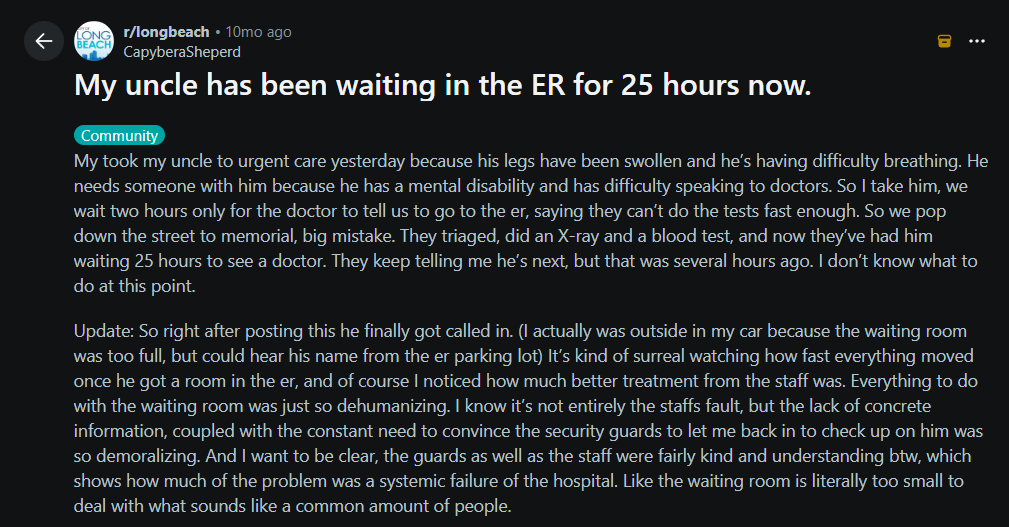
Another user in the thread went on to comment:
I don’t even know where to start, but my partner has stage 4 cancer (originally treated at Memorial), but our visits to their ER were 8 hours, 16 hours, and 23 hours (the last one- he was in a ward but no doctor was “coming around soon” or “about to see him” until 23 hours later)... no food, no water all that time. I am not kidding. I wanted to bring him water from the vending machines but the guards said i could not leave the ER isolation ward in order to go to the vending machines and then be let back into the isolation ward.
Loma Linda University Medical Center has the dubious distinction of being in third place for longest average ER stays in the country, where patients will wait an estimated 7 hours before they are sent home. This hospital had more than 8,000 patients who left without being treated in one year. A review on Google went on to say:
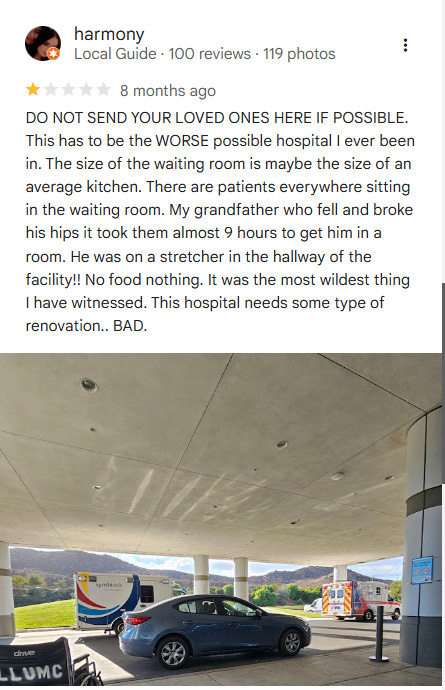
Again, what is presumed to be an elderly man is left to wither in pain in excess of 9 hours before being assigned a room (and subsequently) being afforded access to pain reducing medication.
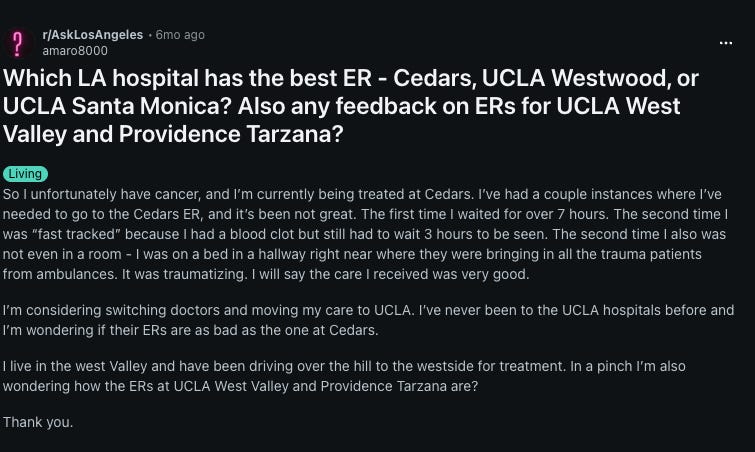
Again, a cancer patient reports an excess of 7 hour wait, and 3 hours with a blood clot which is a potentially life threatening aliment.
Why Is This Happening?
From 2011 to 2021, California’s population grew by 4.2 percent, but the number of emergency departments fell by nearly 4 percent. Meanwhile, ED visits increased 7.4%, with high-severity visits skyrocketing by almost 68 percent.
Hospital beds also fell by 2.5 percent during this period, creating dangerous bottlenecks where admitted patients get stuck “boarding” in the E.R. for hours or days because there’s nowhere upstairs to put them.
The Nursing Crisis
California faces an alarming shortage of nurses that is expected to skyrocket from 3.7% in 2024 to 16.7% by 2033 – a deficit of more than 61,000 registered nurses.
But here’s where it gets interesting: Nurses and their unions argue that this is not simply a shortage of workers it is a management-created staffing crisis. Hospitals stand accused of cutting benefits, piling more patients on each nurse and using expensive traveling nurses rather than building up a permanent local staff.
At UCLA, nurses staged protests about the unsafe practice of locating ER patients in hallway beds and doubling up patients in single-occupancy rooms, with some waiting more than six hours to be seen.
Some Southern California hospitals are experiencing nursing vacancy rates over 30%, a number that is up sharply from the pre-pandemic average of about 6%. Burnout is widespread, and veteran nurses are fleeing the profession altogether
Instinctively you would think it’s pay related but oddly enough, Los Angeles pays nurses competitive wages — an average of $116,110 a year (or about $55.82/hour), which is 40 percent above the national average. But in LA’s brutal cost-of-living nexus that money doesn’t go nearly as far.
Let’s do the math on an average LA nurse:
Gross monthly income: $9,675.83
After taxes (28%): $6,966.60 take-home
Average 1-bedroom rent: $2,488r
Car insurance: $150
Gas: $150
Car maintenance: $50
Groceries: $400
Utilities: $150
Miscellaneous: $200
Total monthly expenses: $3,588
Left over: $3,378.60
At first glance, the amount left isn’t terrible even for California. But rent alone eats up 35.7% of take-home pay — and that’s based on average rent. Rent goes up to $2,700-$3,000+ in safer neighborhoods, or closer to major hospitals etc., bringing the percentage over 38-43%.
Keep in mind the numbers above do not take into account entry level nurses or nurses who also have student loans, families to support, medical bills and various other lifestyle costs.
Food in general has surged, with the price of groceries rising 41% from 2019 to 2025. Egg, meat, and poultry prices in LA jumped 9.8% over the past year.
Mental Health & Homelessness
California already has a notorious homeless problem and this problem is often times turned into a game of ‘pass the buck’; between civil officials, law enforcement, and medical workers. This problem is further exacerbated by rampant drug use in the homeless community (often times leading to homelessness in the first place.) This can also snowball into a mental health crises especially when substances such as PCP or meth are involved.
Under federal law ERs have an affirmative duty to provide medical screening and examination to EVERYONE who comes in; irrespective of insurance or fiscal capacity of the patient. Additionally, the current trend in law enforcement (especially in LA) is not to incarcerate the mentally ill — but — bring them to the hospital as a way to ‘kick the can down the road.’ This further compounds the wait time and service issue at Los Angeles ERs.
Beds to Homeless Ratio
An interesting statistic —
The current homeless population of LA County is estimated at: 72,195
The current ER hospital bed capacity of LA County is 1,973
This creates a stunning ratio of 37 homeless individuals to ONE ER Bed. This ratio highlights the overwhelming strain and pressure that homeless individuals impart on the emergency medicine system of LA County.
25% of homeless adults in LA County are severely mentally ill. California emergency departments served about 143,000 people experiencing homelessness in 2019, with nearly half coming four or more times per year.
Statewide, Medi-Cal paid 70% of homeless patients’ ED visits, an indication that ERs have become the safety net for people who cannot get primary care, mental health services or housing assistance.
These factors create an unsustainable strain on the ER system given the unhoused individuals frequent and medically complex visits which often include a multitude of treatments ranging from mental health, substance abuse, dermal diseases and general health complications of their lifestyle. In turn this has lead medical staff to develop compassion fatigue and burnout — facilities and providers must not only triage patients but also their own human capital and logistics.
Policy Paralysis & System Strain
Another side-effect of California’s bureaucratic state is policy paralysis which is a powerful driver of the ongoing crisis in Los Angeles County emergency rooms. This paralysis refers to the deadlock and delay among policymakers, hospital administrators, and government agencies that result in little or no action on problems like chronic understaffing, inadequate mental health systems, and the lack of affordable housing—all of which drive ER demand higher. This paralysis which has been years in the making has compiled now to a mountain of interconnected problems influencing the medical system.
The systemic infection of the bureaucratic golden state has infected almost every level of their health care infrastructure. Additionally oversight has also turned into a game of ‘pass the buck’ as incidents and reform often fall between the cracks of multiple agencies (state, county, city), causing confusion and paralysis over who should act and who pays. Key state-level programs to address homeless health, substance use, or psychiatric care are regularly delayed, underfunded, or restricted by complicated eligibility rules.
On the ground at the hospital level — if specialized inpatient psychiatric care is needed, the process stalls further. First — the hospital social worker must contact LA County Mental Health to seek an inpatient psych bed, requiring complex paperwork, multiple phone calls, and often physician-to-physician handoffs. These beds are hard to come by as they’re a strain on the tax payer and are not profitable for private hospitals. Even if the bed exists — LA County must approve the transfer, insurance must be pre-authorized, and the availability of beds must be confirmed in real time—a process that may take days.
This creates a traffic jam in the ER department and the problem of — ED “boarding” — when admitted patients housed in the ER can’t be moved to an inpatient bed because there isn’t one available — has become a crisis. This leads to dangerous conditions under which ER patients are treated in hallways, waiting rooms, and improvised spaces. Given HIPAA concerns there is little video or photographic evidence that could be collected for this report. So, first person accounts and online reviews catalog this issue. An unpredictable tidal wave of ED “boarding” can hit an ER department with little to no notice and the nature of the homeless problem in LA makes it almost impossible for departments to predict.
This has lead to ambulance diversions as the contagion spreads to other hospitals. Rural areas are operating at “disaster” status as the new norm. In turn, non-homeless patients and the elderly end up clogged in the traffic jam as well as juggling insurance company foot-dragging and rejection of care related to the backlogs.
Who Bears the Cost?
When safety-net hospitals shut down or begin to divert ambulances, richer nearby hospitals frequently follow, compounding care backlogs. Overcrowding also increases risks to patients, and studies have shown that clinical errors rise when nurses are overwhelmed, fatigued, or forced to triage competing responsibilities.
In 2025 California residents are expected to foot the 355 million dollar bill for the treatment of the unhoused at California emergency rooms. All while California residents also bear the emotional toll of long waits when seeking medical treatment.
With just 1,973 ER beds serving 10 million people, including over 72,000 homeless individuals desperately cycling through emergency rooms for lack of mental health and housing support, Los Angeles County’s emergency care infrastructure is close to collapsing under impossible strain. It’s a moral failure, a financial black hole for taxpayers, and a warning sign that without urgent, transformative action, the system that’s supposed to save lives will be the next casualty.