


The average American family — two working parents and a child — are finding themselves pinched inside a vice of mounting costs. Picture an (average) American family — that makes $100,000 a year (the median income for a family of three), by the time the tax man takes his pound of flesh and basic bills are being paid statistically most should be underwater by about $1,600 a month.
This is what the beginning of a systemic collapse looks like.
Another crack in the foundation of the system: Americans are increasingly dipping into their retirement accounts — with 401(k) hardship withdrawals doubling from 2 percent in 2018 to almost 6 percent in 2024. I estimate this number to be higher since its very hard to track and relies upon the 401k providers to report.
The Foundation: Three-Person Household Income
State median income for a household of three also varies greatly, with the national median at $80,153 and state medians ranging from $76,968 in New Mexico to $182,671 in Washington D.C., according to U.S. Department of Justice and Census Bureau data. For the purpose of this analysis, we’ll use a national average midpoint of about $100,000 in gross annual income.
After federal and state taxes (using an effective 20% rate for this bracket), the family brings home about $80,000 a year, or $6,667 per month.
That might sound reasonable — until you look at where the money is spent and the outlook becomes much more grim. Now put yourself in the shoes of this average American family and remember the $6,667
Death by a Thousand Paper Cuts
The average American mortgage payment is $2,211. Factor in home insurance, security systems and simple maintenance, and housing eats around $2,450 a month alone — 37% of before-tax income before you flip one light switch.
You’re left with $4,367
The Two-Car Bear Trap
In most American suburbs, two cars are not a luxury — they’re a necessity. With only a small handful of American cities being truly walkable (New York City, San Francisco, Boston, Washington D.C., Chicago, and Philadelphia) — This represents another mandatory cost which imparts another deep paper cut into an Americans balance sheet at nearly 30 percent of their take-home pay just to get to work.
It only gets worse from there — a record one in five new-car buyers now make a commitment to monthly payments surpassing a staggering $1,000.
Even with a modest outlook the numbers are still brutal:
Average new car payment: $749/month
Average used car payment: $529/month
Auto insurance (two vehicles): $418/month
Fuel: ~$300/month
Total transportation cost: $1,996 a month
You’re left with: $2,371
Healthcare: The $27,000 Reality
The cost of an average, family health insurance plan offered through an employer rose to $26,993 in 2025 — a 6 percent increase from the previous year and double the rate of inflation. — this is in part due to health insurers passing on COVID related costs to consumers. There is some reprieve when employers pay about 75-80% of this premium, but families still foot the bill for about $550/month in direct contributions (and average out-of-pocket costs of another $125/month for pediatric care…)
You’re left with: $1,696
Utilities and Communications
For a family of three, average monthly costs for utilities and services. typically total around $700-$850. We’ll be generous and leave you with a $700 dollar total spend in utilities. Bear in mind this includes electric, water, cellphone, and internet.
You’re left with: $996
Childcare: The Second Mortgage
The national average expense of childcare ballooned to $13,128 in 2024 — up a staggering 13.3% from year prior levels. That’s $1,094/month, or in places like Massachusetts where parents can expect to pay more than $21,500/year just for one child.
In 45 states and the District of Columbia, annual childcare costs for two kids exceed average annual mortgage payments.
You’re now in the hole for -$98
Food
We are already down to the felt and we still haven’t hit the grocery store yet!
Most families spend from $800 to 1,200 on food every month. Assuming the magic number is $900/mo (groceries + small amount of eating out), that’s another 13.5% over take-home pay.
Child-Related Expenses Beyond Childcare
And taking care of a child doesn’t end at the doors of day care. The ancillary costs include:
Medical expenses (beyond insurance): ~$125/month
Clothing: ~$85/month
Extracurricular activities: ~$100/month
Supplies, diapers, toys: ~$75/month
Total additional child costs: $385/month
The math is a concrete fact of the cold reality that most American’s are living in. American families are likely in an immediate monthly deficit of $1,620 before accounting for a single discretionary expense. No dining out, no streaming services, no emergency fund contributions, no retirement savings, no student loan payments, no clothing beyond what’s budgeted for the child.
This isn’t a story about financial irresponsibility or frivolous spending; it’s the mathematical reality that even families doing everything “right” — working two full-time jobs, carrying insurance, maintaining modest lifestyles — are structurally designed to fail under the weight of America’s cost structure. When the essentials alone exceed total income by nearly 25%, the American Dream isn’t deferred — it’s literally impossible.
The Psychology Behind Lifestyle Creep
Some 32 percent of Americans say they feel financial pressure to keep up with someone — whether it’s a family member, friend or the manicured social-media version of someone’s life posted online. Over 38 percent of Americans confess that they would go into the red over a “fun purchase” — travel (27 percent), dining out (14 percent).
Almost half (48%) of social media users have bought on impulse after seeing a post, and one in five (20%) say they feel negative about their finances having spent time scrolling through other people’s feeds.
The Frivolous Expense Breakdown
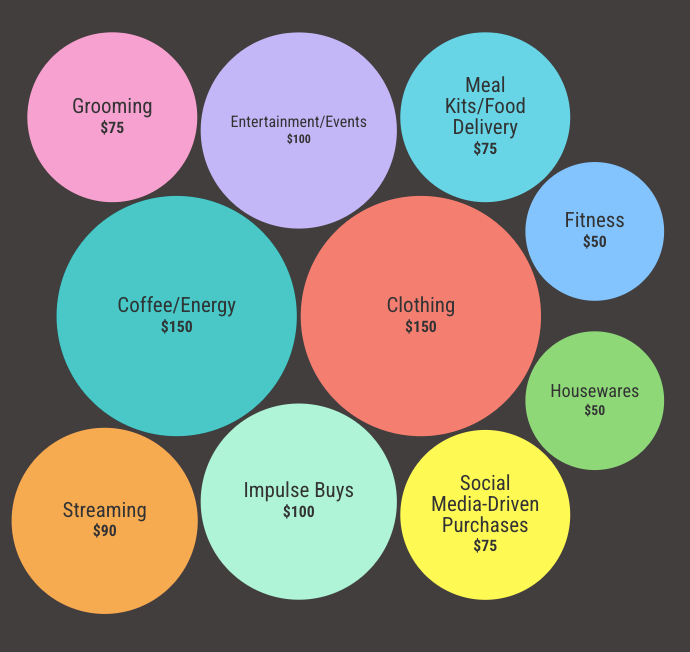
The above expenses adds up to roughly $915 — and admittedly I’m rounding down on a majority of the expenses. The average American now spends $273 a month on subscription services alone — but when asked, most drastically underestimate their spend at ($111.)
42 percent of consumers have forgotten about one or more subscriptions that they continue to pay for, ultimately washing an average of $219 a year on unwatched services down the drain.
The Generational Divide
Millennials take the spending lead at $301/month on subscriptions, with professional software, family streaming accounts, meal kits and children’s apps among some of the items driving their spends. Gen X is up next at $282 a month and the largest share of all “forgotten” subscription spend at 47%.
Over half of Americans (55%) say that they are guilty of frivolous spending, and 74% recognize an issue when it comes to overspending. Of those who say that money does buy happiness, 45 percent acknowledge living a lifestyle that is more expensive than their annual income.
Our fictional family makes $100,000 — much more than the national median household income of $83,730 — but they fall short by $18,172 a year. Where does the void get filled?
—
Credit cards. And increasingly, retirement accounts.
The 401(k) Emergency: Looting the Future
Struggling Americans are increasingly raiding their retirement accounts with a 4.8 percent hardship withdrawals increase up 3.6 percent the previous year and 2.8 percent in 2022. Since tracking of this metric began in 2018 this is the highest it’s ever been. This is a novel metric which is hard to collect concrete data on as it is up to the 401k provider to even keep tabs on this in the first place. This would be a good metric for our government to track, and report on if feasible.
Through May of this year, hardship withdrawals have increased by 28% from the same period a year earlier
Polling shows that between 33-41% of Americans have withdrawn money from retirement accounts before retirement, with average early withdrawal amounts ranging from $2,200 for hardship withdrawals to over $15,000 for full account cashouts. Most who withdraw early do not repay the funds: approximately two-thirds haven’t paid it back in full, and one-third have no intention to do so.
But Why Are They Withdrawing?
The reasons for hardship withdrawals, at the top and even in the middle, paint a picture of financial purgatory where Americans are consistently running in place (or backwards.)
The average 401k emergency withdrawal is roughly $30,000 - which creates a compounding growth plateau. Had that $30,000 been left in a 401(k) for 30 years until retirement at age 65, it would have grown to:
At 7% annual return: $228,368
At 10% annual return: $523,482
For each $1 taken early out of a 401(k), you lose an effective $7 to $17 when taxes, penalties and lost compounding are accounted for.
The Credit Card Cliff
Americans aren’t just cannibalizing retirement — they’re going deep into debt:
U.S. Credit card debt hit an all-time high of $1.21 trillion as of Q4 2024
Average consumer debt: $104,755 — 37 percent of Americans are using credit cards to pay for basic necessities which tracks with the monthly budget calculations presented above. 32 percent of Americans have at-least one credit card at 100% utilization (a/k/a ‘maxed out’)
Total household debt has ballooned to $18.59 trillion
To put this in perspective — the average American household starts every year already owing more than a year and a half’s worth of labor before they pocket a single dollar. It’s the financial equivalent of running an 18-month marathon before the race even starts — and the race never ends because the debt keeps growing! — meanwhile — personal savings rate has plummeted from 8.9% in 2020 to a paltry 3.5% in Q4 of this year. The share of credit card accounts that can only afford minimum payments reached its highest level in 12 years, or 10.75%.
The Joneses are broke, too.
Maybe you finally catch up with the joneses only to realize they’ve been running in place the entire time. The uncomfortable reality is that the Joneses — those neighbors with all the shiny new cars, remodeled kitchens and vacation pictures from Europe on Instagram — have giant cinder blocks strapped to their ankles. And the math doesn’t lie: The average American family of three can barely afford to live much-less thrive.
With all the data presented above it is clear the Joneses are going broke trying to look rich in this modern day financial prisoners dilemma. Neither side of the fence likely knows either are struggling.
It makes you wonder how much further this rock can be kicked down the road until it knocks down the house of cards.