


Oura has decided to pause its plans for an IPO. Our last article on Jersey Mike’s highlighted the unforeseen risks to initial investors that are oftentimes buried under flashy non-GAAP adjusted EBITDA metrics. We believe there are additional headwinds facing Oura beyond the frothy macroeconomic conditions.
Market research firms do not include ‘smart rings’ generally, in the wearable category. Oura reported selling 3.6 million rings over the twelve-month period ending on June 30th of 2026 which represents only 2% of global wearable shipments. For comparison, on a blended basis1 Apple represented ~16.3% of the 46.6 million-unit global wearable market as tracked by Omdia.
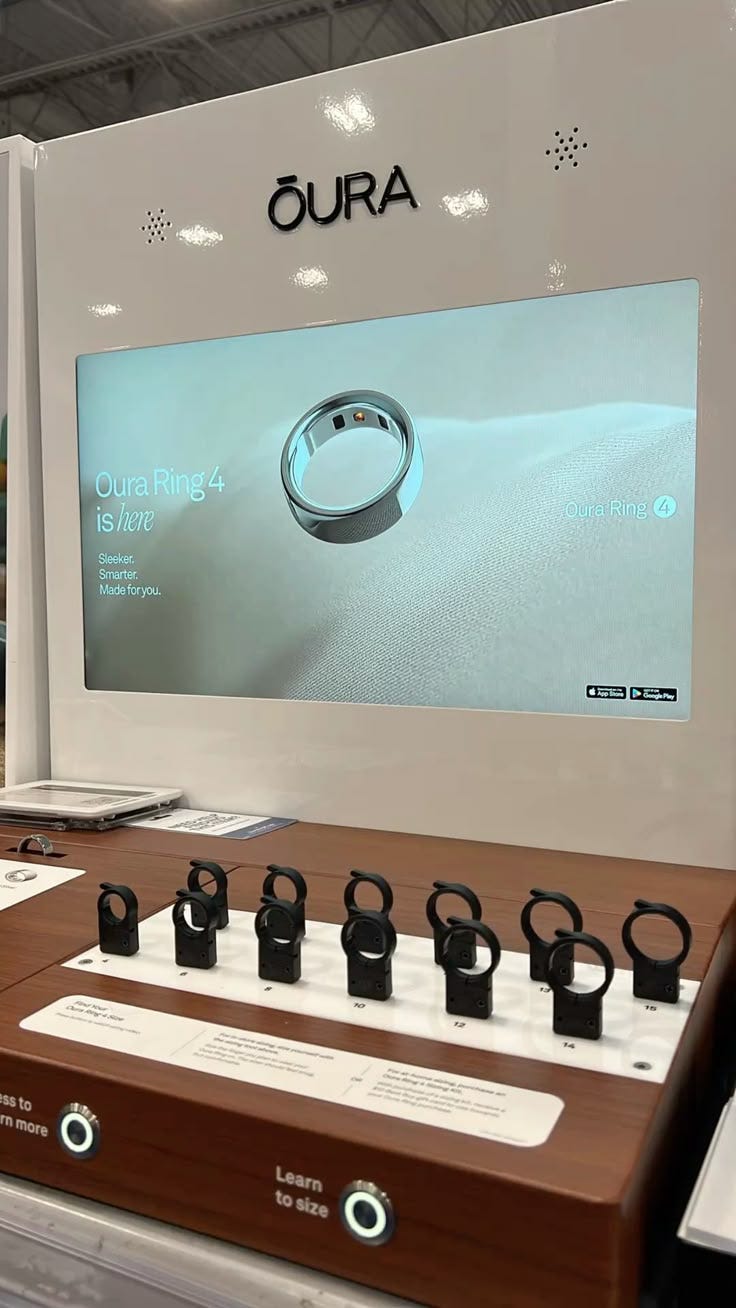
The health wearable industry has a unique competitive factor that established companies like Apple can generally get away with:
“Build it, and they will wear it.”
Newer entrants (such as Oura) simply cannot utilize this same approach.
Pictured above, Oura manufactures and sells an admittedly state of the art tertiary (if you have a smart watch) health device.
The keyword here is,
tertiary
When you have a tertiary product, consumers must be convinced to purchase it, and how do you convince a consumer to wear such a product? Marketing.
This requires significant CapEx, which must be deployed to:
Convince consumers that your sensor is better than the ‘good enough’ sensors on wearables offered by the likes of Apple and Samsung.
This can only be accomplished through aggressive marketing.
Convince consumers that your monitoring platform is better than the ‘good enough’ Apple Health, which is effectively free.
This can also, only be accomplished through aggressive marketing.
Now, convince consumers that a dedicated ring is needed atop the wearable they already own.
Finally, convince (and continue to) consumers that the subscription is worth paying for.
Oura’s first hurdle is convincing consumers that the incremental gains in finger based reading are worth the price of admission. They accomplish this by pointing to a science organization with a litany of PhDs and medical doctors and over 175 peer-reviewed publication; which state finger based sensing is superior in accuracy to wrist based sensors.
Next, and the arguably more difficult task is to convince customers that an additional Oura Membership is worth paying for when Apple Health offers a good enough health dashboard at next to no cost.
Apple has a ‘default-distribution advantage’ with any current handset owner—they can distribute their software by default. If you own an iPhone the direct software competitor to Oura is already installed on your phone. Oura now has a two front battle to fight against consumer behavior—financial & behavioral: prospective and current customers must be continuously convinced to open another app, pay another membership fee, and understand and see the value in a new set of scores (especially if they’re a current Apple Watch users) while not seeing the data as redundant.
For the most part, marketing can add velocity to any business especially if it is executed in a clever or artful manner: NoVig is a great example of this.
Marketing is not free. It is a significant line item for any company even more so if you’re directly competing with an entrenched tech titan with default distribution as their home-court advantage. With all of this in mind, it creates a recurring marketing obligation, where Oura must continuously explain their scores are more important and actionable than the default Apple Health app alone.
Even the first bullet of their growth strategy admits to this headwind:

This is the core breaking point in the Oura IPO. They must aggressively compete for market share and lobby for the attention of current consumers and provide continuous education and a compelling value proposition to existing customers so they can prevent churn; consumers, who, may already have a good enough health-monitoring device on their wrist.
Even in a scenario where there is a higher than expected return on ad spend, we still see near-term margins compressing.
Our blended calculation includes wrist / rings