


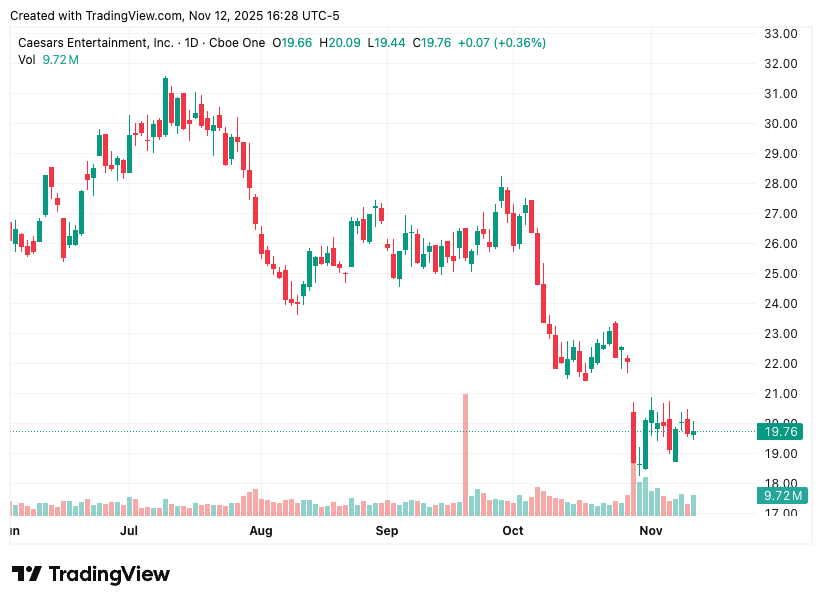
Caesars Entertainment (here-in “CZR”) digital business (which consists of the successful sportsbook and iGaming operations) is showing strong growth, the market refuses to pay shareholders a valuation that matches recent performance. And now that activist investor Carl Icahn has his own representation on the board and is openly advocating for the exploration of “strategic alternatives,” it’s time for CEO Tom Reeg to take an aggressive step: spinning off Caesars Digital into a separate public company.
On their most recent earnings call for the third quarter of 2025, management described strong momentum in their digital segment, which includes the sportsbook. Online sports betting volume increased, with overall handle rising, and iGaming revenue grew at a solid pace. However, executives noted that sportsbook margins were pressured in September due to less favorable sports outcomes—an issue impacting the entire industry at the time
The math is compelling. Caesars Digital tallied $1.2 billion in 2024 revenue, with adjusted EBITDA more than tripling to $117 million for the year. Digital EBITDA again doubled YoY up to Q2 2025 at $80m, cementing the business firmly on a path towards management’s ambitious annual EBITDA target of $500m. But despite this momentum, the stock of CZR stock is still fetching a market cap of about $4 billion — and analyst projections indicate that the digital unit alone could be worth in excess of $6 billion on a standalone basis.
This disconnect isn’t theoretical. Analysts have recently pegged the value of Caesars Digital at $6.25 billion under a conservative 12.5x EBITDA multiple, and as high as a stunning $9.6 billion applying the 19.2x average multiple that pure-play digital operators such as DraftKings and Flutter enjoy. This suggests that the digital business could be worth more than what the whole company is valued at now. For shareholders who have witnessed CZR fall over 50% in the last year while their digital business thrives, management’s continued silence and lack of imagination is reprehensible.
Divided by the Rubicon
Caesars Digital is a drastically different business from the company’s brick-and-mortar casino empire. Online sports betting and iGaming are high growth, technology-enabled platforms with >30% revenue expansion and fast improving margins. Digital first online operators are able to leverage betting on demand via smartphone applications. Compare that to a regional casino and Las Vegas markets, which have maturation headwinds, property upkeep, wage cost pressures, and a reliance on cyclical consumer spending trends.
When this polarity is packaged in one stock it’s difficult for investors to properly value either of them. Investors can grow frustrated with the capital-heavy real estate business and $11.9B in term debt, shy away from exposure here. Moreover, CZR stock and its heavy weighting of brick-and-mortar operations falls victim to the headwinds of declining tourism in their flagship operating city.
A split would let both businesses optimize their capital allocation strategy. The digital-only-company could spend aggressively on customer acquisition, marketing, promotions, product development and geographic expansion — all underwritten by investor types who appreciate the payback dynamics of online gambling. Meanwhlie, the brick-and-mortar Caesars could concentrate on cutting costs, debt pay-down, and property improvements before beginning to return cash to shareholders in form of dividends and buybacks.
Pure-play digital first operators like DraftKings and Flutter’s FanDuel have structural advantages in attracting talent, compensating in equity value, and M&A strategy that CZR simply can not match. By being given its own currency and autonomy, Caesars Digital management would be able to make this business a better competitor for customers and employees.
Lastly, the digital first sports betting market is largely a duopoly controlled by two dominate operators (Draftkings / FanDuel) with all factors considered above a digital only Caesars would be free to focus on market share battles without the ball and chain of their brick and mortar properties.
The Debt Deleveraging Catalyst
Another compelling reason for a spinoff may be the company’s crushing debt load. CZR has about $11.9 billion in net debt, which is more than 6x its drastically reduced EBITDA; that leverage ties the company’s hands on many fronts and drags down the stock multiple, while requiring management to sacrifice growth investments for deleveraging.
Monetising the digital business to a degree would solve this problem directly. Even if Caesars held on to 50% of the digital entity after a spinoff and sold the remaining half to public investors, the price tag could be eye-popping. Applying the $6.25 billion conservative valuation (which in normal times would represent close to 9x 2014 pro forma earnings before EBITDA and at today’s debt multiple figures, closer to 11x free cash flow) an 80% monetization would yield something like $5 billion (net of fees). Assuming that capital was put toward paying down debt, it would reduce annual interest expense by around $350 million at the current rate level which is a huge boost to free cash flow and earnings power.
Caesars pays an interest rate of roughly 9.25% on its debt, which is high enough to eat away at any profitability that it generates even as operations improve. In contrast, the digital business is turning into a very real cash cow with better unit economics and lower customer-acquisition costs relative to lifetime value. Locking in those gains with a debt pay-down now would allow the remaining Caesars business to move forward with long-term value creation.
The company has already shown its readiness to do asset sales and deleveraging. Management made $546 million in debt payments during 2025, and have repurchased $391 million worth of stock since mid-2024. But these are baby steps compared to what a spin-off could do for the company.
Legal and Regulatory Hurdles
Pulling off a spinoff would involve wading through a tangle of legal and regulatory red tape. Gaming companies have their own unique set of issues that few other corporate separations ever face.
Gaming License Complications
The first of several hurdles is gaming licenses. Each state has a gaming authority which mandates that operators be licensed, and the licenses are categorically non-transferable without regulatory consent. In any state that wants to license or transfer licenses to a spun-off Caesars Digital, a new company would be required to acquire or have licenses transferred for all of the 20+ states in which it operates today. This process typically involves:
• Comprehensive background checks and suitability findings for new entity directors, officers and material shareholders
• Sufficient capitalization and operational capacity demonstrated
• Evidence that responsible gaming policies and compliance mechanism are in place
• Public hearings and review periods that can take 6-12 months or more
Other regions, such as Nevada and New Jersey, have especially strict rules related to changes in corporate structure. Under Nevada gaming regulations, the Gaming Control Board can scrutinize any persons acquiring over 5% of voting securities and may require divestiture if the owner is found unsuitable. Review would be sucked in for rounds of review, in all of those states at the same time — by a spinoff that has new public shareholders.
The good news is Caesars Digital already license in each jurisdiction and are one of the few that possess a mobile-ready license. Additionally, the new corporation would be able to lean on the credibility of the Caesars brand.
Satisfying VICI’s Requirements
Any spinoff scenario has to deal with the 800-pound gorilla in the room: VICI Properties (NYSE:VICI), the real estate investment trust that owns most of Caesars’ casino properties and has its operations in a financial chokehold. I wrote an article extensively covering VICI.
Caesar's Got Left Holding the Bag

This is the second article in my series about Caesar’s Entertainment to provide context on VICI properties. The first article is here.
In brief, VICI was formed in 2017 as part of Caesars’ bankruptcy restructuring and became a public REIT that was split off from Caesars, with itself entering into long-term triple-net lease agreements with Caesars for its prime properties. The real estate for Caesars Palace Las Vegas, Harrah’s properties and many regional casinos is now owned by VICI. Cash Rent Obligations. Caesars pays around $1.5-1.8 billion in rent each year to VICI under several master leases.
These leases are structured with fortress-like protections for VICI:
• Cross-defaults: A default under one property results in a default across the entirety of the properties subject to the master lease
• Guaranties: Caesars Entertainment parents guarantees all lease obligations, not just individual property entities
• Minimum capital spending: Leases mandate that Caesars spend at least 1% of revenue for upkeep and improvements to property — money used for buildings owned by someone else.
• Non-transferability: Leases would limit Caesars’ right to assign or sublease properties without VICI’s consent
Importantly, VICI’s leases contain financial covenants and operating conditions that govern its jurisdictional overlordship of Caesars’ operations. If Caesars enters into any transaction that has a “material adverse effect” on its financial profile, or separates its assets that generate cash, it could lead to covenant breaches or require VICI’s prior approval.
Structuring Around the VICI Constraint
How can Caesars spin off its most rapidly growing, most valuable business unit without undermining its ability to meet VICI’s rent demands?
The key is using clever financial engineering and ensuring that there is enough EBITDA at the holding company level. VICI is mainly concerned with rent coverage — the multiple of Caesars’ EBITDA to its lease obligations. According to industry norms, casino operators should enjoy rent coverage of between 1.5-1.8x for their operations to be sustainable. (Caesars currently is running around consolidated EBITDA of $3.6-3.7 billion and can easily cover the rent it pays VICI).