


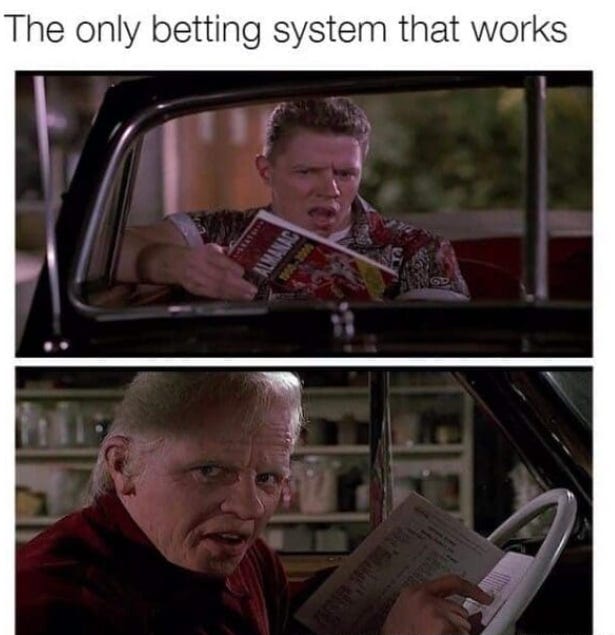
Thanks in part to Online Sports Betting (OSB) being legal in 32 states (incl. PR and DC) — The sports betting landscape has transformed more in the past seven years than in the previous seven decades. What was once the equivalent to the Costco foodcourt in Casinos has exploded into a $120 billion industry. In 2024 — Americans legally wagered $119.84 billion on sports.
The old-school Vegas sports-books actually didn’t have too much of a problem with players winning. They operated as “loss leaders,” offering competitive odds and taking slim margins because they knew the temptation you’re facing and you’d eventually wander over to the blackjack tables or slot machines where the real money was made.
Today’s digital first sports-books are a different beast entirely. Armed with artificial intelligence, behavioral psychology, and data analytics that rival some nation states modern betting platforms have perfected the art of separating you from your money. Yet a small group of sharp bettors continues to beat the system—which is exactly why the books have developed increasingly aggressive tactics to neutralize them.
Whether you’re a casual bettor throwing $20 on Sunday Night Football or someone curious about why your winning friend suddenly can’t bet more than $11 per game, this article will explain how the industry works and the meaning behind those weird +100/-110 numbers next to game scores on TV.
How We Got Here
A legal online sports-book market did not exist in its current form until 2018, when a Supreme Court decision allowed states to legalize sports betting. DraftKings and FanDuel, which began the decade as daily fantasy sports companies, were able to use their massive customer lists, technology, and sports partnerships to instantly capture double-digit market share as sports betting began to roll out nationwide. Over the next several years, both companies rapidly expanded their lead, pushing out legacy brands and thwarting the ambitions of new entrants. Other brands like BetMGM and Caesars steadily gained ground but never challenged the duopoly at the top, while media entrants (like ESPN BET) and newer operators (Fanatics) carved out only small slices of the market. To date the market remains at a bit of duopoly with DraftKings and FanDuel together nearing 80% market share, with slight market share concessions falling to Caesars and BetMGM.
From Their Loss Leader to Yours
Walk into any Las Vegas casino in 1985, and you’d find the sportsbook tucked away in a corner, offering surprisingly good odds on games. Casino executives viewed these books as marketing expenses. They’d accept bets with a 4-5% house advantage (called the “hold” or “vig”), sometimes even less on major events, knowing they’d lose money on sharp bettors. The strategy was simple: get sports fans through the doors, let them have some fun betting games, then hope they’d stick around for roulette, craps, or slots where the house edge ranged from 5-25%.
The sportsbook was a traffic driver, nothing more. Casinos were perfectly content operating these books at break-even or even slight losses because the overall customer lifetime value made it worthwhile.
In the aforementioned May 2018 decision, the Supreme Court struck down the federal ban on sports betting, and the new mobile gold rush was on.
Mobile betting eliminated the expensive real estate, upkeep, and employee salaries. Suddenly, operating a sportsbook cost a fraction of what it did in the analog era. Even better for the books, customers could now bet impulsively from their couches at 11 PM on a Tuesday, placing bets they never would have driven to a casino to make. The volume exploded, and with it, the profit margins.
Modern mobile sportsbooks now operate with hold percentages of 7-10%, sometimes higher on popular prop bets and parlays. Books have introduced same game, and even same drive parlays. These are hundreds of micro-betting option like will the next pitch be a ball or strike? or Will this drive result in a first down? The tempting odds and ease of access make these bets very tempting to bettors and profitable to the books. What was once a loss leader has become one of the most profitable segments of the gambling industry, with companies like DraftKings and FanDuel posting revenues that would make traditional casino operators envious.
How They Stack the Deck
If you think sportsbooks simply post lines and passively accept action, you’re playing checkers while they’re playing 4D chess. Modern betting platforms employ sophisticated technology and psychological tactics that give them edges most bettors never see.
The line you see might be different from the line I see on the exact same game, at the exact same time, on the exact same platform. Sportsbooks now use dynamic pricing algorithms that adjust odds based on who’s betting.
If their system identifies you as a recreational bettor—someone who bets favorites, loves parlays, and has a losing track record—you might get slightly better odds to encourage more action. But if you’re consistently betting underdogs, hitting less popular markets, or showing a profit, you’ll see tighter lines and worse prices. The books call this “customer optimization.” Bettors call it what it is: discrimination against winners.
These algorithms adjust lines in real-time based on betting patterns across thousands of accounts. When sharp money hits a line, it moves instantly. But the speed and direction of the move might vary depending on where that money came from. It’s a fluid, personalized pricing system designed to maximize the book’s edge against every individual bettor.
The Player Profiling System
Every single bet you place is feeding a profile. The sportsbooks know your win rate, your average bet size, what times you bet, what sports you prefer, how quickly you place bets after lines are posted, whether you shop lines across multiple books, and hundreds of other data points.
They’re looking for patterns that indicate “sharp” behavior
A sharp or an advantaged player (AP) is an experienced, knowledgeable, and analytical gambler who uses skill, data, and a mathematical edge to consistently profit over the long term, rather than relying on luck or chance.
The books track a wide set of behavioral and statistical signals to identify sharp bettors. Key indicators include betting right when lines open or just before major movement, placing large wagers especially in low-traffic windows favoring straight bets over parlays, and consistently targeting soft or obscure markets. Sharps who regularly beat the closing line, influence odds when they wager, or show unusually high win rates across sports are flagged quickly. Modern operators use AI to monitor timing, size, frequency, market impact, contrarian positioning (arb plays), and account activity, then escalate suspicious action to human traders for review. Together, these datapoints create a real-time risk profile that helps books spot and manage professional bettors.
Sharps generally mitigate these tracking methods by having “beards” or “smurfs” place bets for them on their behalf. If you go to any Vegas sportsbook you’ll see dozens of individuals placing bets while reading bets on a phone, or while taking direct phone-calls.
The Math Behind “Risk-Free” Bets
There is no such in life as a free lunch, and the saying stands true in gambling. Nothing in gambling is risk-free, despite what the ads claim. Those promotional offers are masterclasses in behavioral economics designed to keep losing players active while providing minimal value to winning players.
A typical “risk-free bet” promotion works like this: bet $100, and if you lose, you get $100 in bonus credits. Sounds fair. But those bonus credits come with restrictions. You usually can’t withdraw them—you have to bet them, often multiple times (called rollover requirements). If you win with bonus credits, you might only get the profit, not the original stake back. The books know that most players will lose those bonus bets too, or win them but then keep playing with their winnings until it’s down to the felt.
Loss rebates are even sneakier. “Lose $500, get $100 back!” sounds generous until you realize they’re specifically targeting losing players and giving them just enough rope to hang themselves with one more betting session. These promotions have been mathematically optimized to maximize customer lifetime value while appearing generous.
Stepped Off
via: Alex Monahan - Youtube
“The House Always Wins”
Being stepped off is industry jargon for when a sportsbook restricts how much you can bet. Instead of your standard $1,000 maximum, suddenly you can only bet $50, or $11.47, or some other insultingly small amount. It’s the book’s way of saying: “We know you’re beating us, so we’re making you irrelevant.” The player in the above video has clearly won too much on Draftkings and has subsequently been “stepped off” — moreover there is compelling evidence that like car insurance companies that Sportbooks routinely share lists of verified and known sharp players.
This happens far more frequently than the betting public realizes. Win consistently for a few months, show sharp betting patterns, or hit the right combination of red flags, and you’ll be stepped off. The thresholds vary by book, but generally, if you’re showing a profit of more than 5-10% on several hundred bets, you’re at risk.
The books defend this practice by saying they reserve the right to refuse action from anyone, just like a casino can ban card counters. The reality is they want a specific customer: the recreational bettor who loses slowly enough to keep playing but never threatens their bottom line.
Different sportsbooks have different reputations in the sharp betting community. Pinnacle and Bookmaker are known for taking larger bets from winners. Books like DraftKings, FanDuel, and BetMGM are notoriously quick to limit successful bettors. Some books like Circa Sports in Las Vegas pride themselves on welcoming sharp action, but they’re the exception.
Beard Betting
Beard betting is a tactic sharp bettors use to still lay action on sports. The term comes from espionage slang for a person used to conceal someone else’s identity.
Here’s how it works: A sharp bettor who’s been limited across multiple books will recruit friends, family members, or even pay strangers to open accounts and place bets on their behalf. The sharp bettor identifies the opportunity, sends the beard the details (which game, which bet, how much), and the beard places the wager. In return, the beard gets a cut of the winnings or a flat fee.
Sportsbooks employ sophisticated detection methods such as tracking IP addresses, device fingerprints, betting patterns, and even behavioral biometrics like how quickly you tap buttons or scroll through menus.
The books also look at funding sources. If five different accounts are all funded from the same bank account or payment app, that’s an obvious tell. Smart beard operations use completely separate funding, different devices, different locations, and stagger their betting times.
Is beard betting legal? That’s murky territory. It’s definitely against the terms of service of every sportsbook, so accounts can be closed and funds potentially seized. Some states have identity fraud laws that could theoretically apply if you’re betting under someone else’s name. But prosecutions are extremely rare—usually, the worst consequence is losing your account and any winnings in it.
Artificial Intelligence
If you think sports-books are high-tech now, you haven’t seen anything yet. Artificial intelligence is transforming how odds are set, how risk is managed, and how players are profiled.
Traditional oddsmaking relied on experienced bookmakers with deep sports knowledge. Today, machine learning models ingest vast amounts of data—player stats, weather conditions, injury reports, historical trends, and generate opening lines. These models can spot patterns and correlations that human oddsmakers would miss.
But AI’s biggest impact is in risk management and player profiling. Modern systems can identify sharp betting behavior within a handful of bets by comparing your patterns to known sharp profiles. They can predict which players are likely to become profitable long-term and proactively limit them before they’ve even made much money.
Some books are even using AI to optimize their promotional offers on a per-customer basis, determining exactly how much bonus money each player needs to stay engaged without being so generous that it erodes profit margins.
The sharp bettors are fighting back with their own AI tools. Sophisticated betting syndicates use machine learning models to find edges in pricing, identify arbitrage opportunities, and even predict line movements. It’s an arms race, with both sides employing increasingly advanced technology.
Event Contracts: The Disruptor No One Saw Coming
While sportsbooks were perfecting their systems to extract maximum profit, a new competitor emerged from an unexpected direction: prediction markets, specifically Kalshi and similar platforms offering “event contracts.”
Event contracts are derivatives that pay out based on whether specific events occur. “Will Team X win the championship?” can be traded as a contract that pays $1 if yes, $0 if no, with the price fluctuating based on market sentiment. Technically, they’re not “gambling”—they’re regulated by the Commodity Futures Trading Commission (CFTC) as financial instruments.
This distinction matters enormously. Prediction markets don’t limit winners. They can’t, because they’re simply providing a marketplace where participants trade contracts with each other. The platform takes a small transaction fee regardless of who wins, so they have zero incentive to ban successful traders. In fact, they want sharp traders because it improves market efficiency and liquidity.
The launch of Kalshi’s sports markets in late 2023 sent shockwaves through the sports betting industry. Finally, sharp bettors had a haven where winning wasn’t a liability. Better yet, the tax treatment is often more favorable—profits can be treated as capital gains rather than gambling winnings in many cases.
Arbitrage Opportunities Between Markets
Here’s where it gets really interesting: because sportsbooks and prediction markets use different pricing models and serve different purposes, pricing discrepancies regularly appear. This creates arbitrage opportunities—risk-free profits by taking opposite positions across platforms.
A quick breakdown on the lingo
Like any industry sports betting in particular is conflated with various lingo and jargon to make it sound more scary than it actually is.
Favorites (Negative Odds, e.g., -150): Indicated by a minus sign; shows how much you must bet to win $100 profit . For -150, wager $150 to win $100 (total payout $250, including stake). Think of the minus as the money you have to part ways with to make 100 dollars.
Underdogs (Positive Odds, e.g., +150): Indicated by a plus sign; shows how much profit you win on a $100 bet . For +150, wager $100 to win $150 profit (total payout $250, including stake) Think of the + as the money you’ll make if you only bet 100 dollars.
For example, a sportsbook might offer the Chiefs at +150 to win the Super Bowl while Kalshi’s “Chiefs win Super Bowl” contract is trading at 35 cents (implying +186 odds). A sharp bettor could bet the Chiefs on Kalshi and bet against them on the sportsbook at odds that guarantee a profit regardless of outcome.
These opportunities are usually small and don’t last long, but they exist because sportsbooks are managing customer-based risk while prediction markets are simply reflecting market sentiment. The sportsbook might be shading their Chiefs price down because too many recreational bettors are pounding them. The prediction market doesn’t care about customer flow—it just reflects what traders think the probability is.
As prediction markets gain mainstream adoption, we’re seeing more sophisticated arbitrage operations. Some syndicates have automated systems that scan for discrepancies across dozens of platforms and place trades within milliseconds. The profit margins are small, but volume and frequency make it worthwhile.
There are also intra-game arbitrage chances which I will post about in an upcoming article.
Looking Forward
The sports betting landscape of 2025 looks nothing like 2018, and 2030 will likely be unrecognizable from today.
Consolidation is accelerating. Smaller sportsbooks can’t compete with the technology budgets of giants like FanDuel and DraftKings. We’ll likely see the market narrow to 3-4 dominant mobile books plus a handful of niche players.
Prediction markets are expanding. If Kalshi and similar platforms gain full regulatory approval for comprehensive sports markets, they could siphon off the sharp action entirely. This might actually be good for traditional sportsbooks, who can then fully optimize for recreational bettors without worrying about balancing sharp action.
In-game betting is exploding. Live betting already represents 30-40% of handle on some platforms, and that percentage is growing. The profit margins on these bets are even higher because the odds move so quickly that most bettors can’t shop around or analyze them properly.
Microtransaction betting is emerging. Some books are experimenting with bets as small as 10 cents on extremely frequent events. Think of it like slot machines but for sports—high frequency, small bets, massive volume, and psychological hooks that keep you engaged.
The regulation question remains murky. Are these prediction markets really financial instruments or is that a legal fiction to avoid gambling regulations? Courts will eventually weigh in, and their decisions could reshape the entire industry. If a higher regulation friendly president is elected event contract markets could start to dry up.
The game isn’t unbeatable, but you should know exactly what game you’re playing before you place your first bet.
If you know a gambler who has no idea what they’re doing please consider sending them this article.