


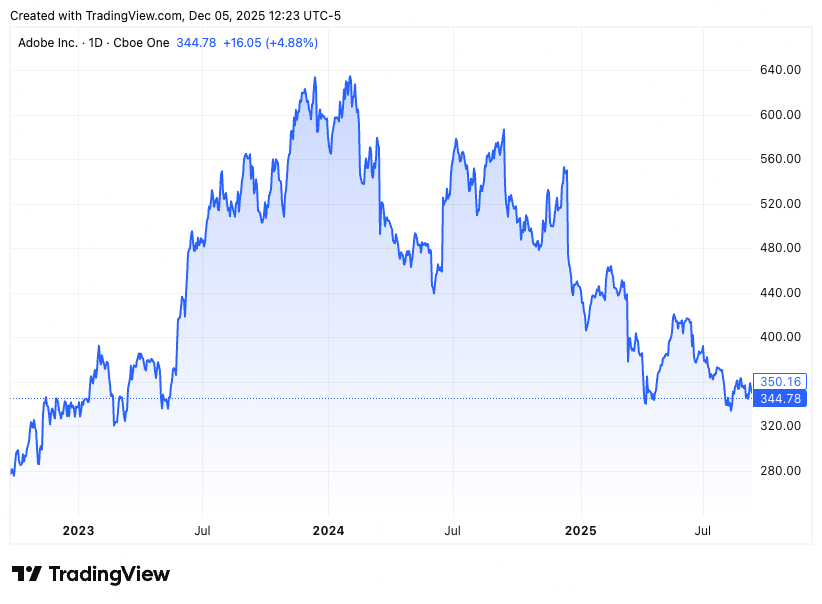
Adobe Inc — ADBE 0.00%↑ — has been getting unjustly hammered over the past year—down nearly 38%. The market has unjustly sold-off Adobe in paranoid fears of AI disruption, but Adobe is unlikely to be disrupted; because they’re more like to be the disruptor. This is a textbook case of the market throwing the baby out with the bathwater and thereby creating one of the most attractive entry prices for a quality software franchise of the last several years. And a patient investor just may get a nice Christmas present at a hefty discount.
We’ll cover Adobe’s impressive fundamentals which is clear sign of upside potential!
A Cash Machine Trading Like It Is Broken
So why does this stock trade at only 21.5x trailing earnings and about 19x forward earnings—levels not seen for Adobe in more than 10 years? By way of context, Adobe has historically commanded P/E multiples of 35–50x. The street has unjustly punished this stock over inflated fears of competitors like Canva—and this price now suggests that the market sees Adobe’s growth narrative as basically complete and, perhaps just as importantly, as I’ll illustrate—the evidence simply does not back this assertion.
Adobe’s margin profile remains exceptional. With gross margins at an impressive 89%, but even then there still remains one metric which displays impressive business acumen by management:
Adjusted Operating Margin—which is the percentage of every dollar of revenue a company keeps as profit after paying its regular running costs.
The typical percentage for software companies is 20-30%:
ServiceNow: 33.5%
Intuit: 27%
Workday: 9%
Snowflake: 9%
Adobe on the other-hand is king of the hill with 46% adjusted operating margin.
This is clearly not a business in retreat, but a cash-printing machine locked inside a fortress.
Adobe is consistently increasing its free cash flow. On a trailing twelve month basis free cash flow for 2025 is roughly $9.5 billion (up from $7.9 billion in FY24.)
Moreover, the company maintains a war-chest of $4.9 billion in cash (or equivalents) - this allows the company a high degree of agility to internally fund AI research, acquisition, and other competitive ventures.
But what is management doing with such a large treasure chest? They are buying back shares aggressively. In March 2024, Adobe announced a $25 billion stock repurchase program, and since then they have repurchased about $14.9 billion worth of shares through May 2025, or, to be precise, 29 million shares. With current prices near $345, this buyback authorization has a ton of dry powder left in the tank.
Adobe Firefly – a Competitive Moat
There is an impressive moat surrounding the castle holding the cash machine. And this is what the bears fail to see. They cling to a narrative that AI tools such as Midjourney, Sora, and Canva will “unbundle” Adobe and this is categorically incorrect.
Firefly is Adobe’s generative AI engine. It can generate and edit images, videos, audio, text effects, and even character art from simple text prompts, and it’s wired directly into tools like Photoshop, Illustrator, Premiere Pro, and the Firefly web app.
Adobe’s AI is also safe for commercial use because it is trained on licensed content to minimize copyright issues. This is a big deal for enterprise clients facing significant legal risk. If copyright exposure is unclear, a Fortune 500 company is not rolling out Midjourney across its marketing organization; it will opt for Adobe Firefly as it aligns with existing workflows and offers legal indemnification.
Adobe also offers Custom Models that enable enterprises to train Firefly on their specific brand assets and visual language. The switching cost is tremendously sticky because once an organization invests in building a customized model that knows its brand, it is not going to switch easily. Instead of AI being treated as yet another commodity tool, Adobe makes AI built-in infrastructure for brands.
Where Adobe falls short, however, is marketing Firefly to the casual user. The casual image generation market is admittedly dominated by ChatGPT, Gemini etc. But Adobe’s enterprise integration, name recognition and B2B dominance remains unmatched by these casual platforms.
Analyst Views and Price Targets
Despite the selloff, Wall Street remains broadly constructive on Adobe. The stock carries an average “Buy” rating and an average price target near $454, implying about 31% upside from current levels.
Even the bears have price targets that do not require a dramatic additional drawdown from here. Adobe’s management consensus view is that FY2025 will be the first year Adobe shows meaningful AI monetization, and AI-influenced ARR is already “in the billions,” according to management.
Bull Case Price Target: $475–550 in the Next 12–18 Months
Conservative case ($425): Adobe rebounds to 26.5x trailing earnings as AI fears cool. That would imply roughly 23% upside and would still be a cheap multiple historically for the company.
Base case ($475–500): Adobe demonstrates AI monetization in FY2025 earnings and re-rates to about 30x earnings. Digital Media and Experience segments remain 10–12% growers, and buybacks are EPS accretive. This represents about 38–45% upside.
Bull case ($550+): AI accelerates net new ARR growth, Firefly becomes significantly accretive to revenue, and the market re-rates Adobe toward historical multiples. Along with roughly 5% annual share count reduction from buybacks, EPS growth ramps to 15%+, which could warrant a 35x earnings multiple and roughly 60% upside.
The market will be watching a very near-term catalyst earnings report which is due December 10th. With 11.5 million shares sold short the stock could see a small squeeze upward, especially if Adobe delivers clear AI monetization metrics and offers constructive FY2026 guidance.
No bull case is complete without real risk acknowledgment:
Competitive intensity in AI: If open-source or free AI tools receive meaningful upgrades, Adobe’s pricing power could be reduced.
Digital Experience cyclicality: Growth in this segment could slow if enterprise spending softens in a weaker macro environment.
Regulatory overhang: The ongoing FTC investigation into subscription practices may lead to operational changes and a lingering overhang over the next 12–18 months.
Execution on AI monetization: For the bull case to hold, Adobe must continue to show real dollars from Firefly and related AI features, not just impressive demos.
The Bottom Line
At roughly $345, Adobe looks like a Christmas gift waiting to be unwrapped by patient investors. For a forward earnings multiple under 20x, you get an 89% gross margin / 46% adjusted operating margin monopoly-like franchise generating almost $10 billion in free cash flow per year, an aggressive buyback program, and a genuine moat in enterprise AI. The market appears to be pricing in disruption that is not coming. The stock has been a source of frustration in 2024–2025, but that frustration is diverging sharply from the fundamentals.
A reasonable 12-month price target is $475, and with faster-than-expected acceleration in AI monetization, the stock could plausibly trade into the $500+ range.
Those $430–490 targets represent roughly 38–45% upside from current levels, with a clearly defined floor in the $311–315 support zone.
When the market offers world-class software businesses at historically low valuations, disciplined investors should be ready. Today, Adobe is that opportunity.
THIS IS NOT INVESTMENT ADVICE
THE CONTENTS OF THIS ARTICLE DO NOT CONSTITUTE INVESTMENT ADVICE, AN OFFER, SOLICITATION, OR RECOMMENDATION TO BUY OR SELL ANY SECURITIES OR FINANCIAL INSTRUMENTS WHATSOEVER.
All information provided hereto is for informational and educational purposes only and reflects solely the author’s personal views as of the stated publication date. The information has not been tailored to the individual circumstances, investment objectives, or financial condition of any reader, and should not be relied upon as the basis for any investment, trading, or other financial decision.
Readers are expressly advised to undertake their own independent research and consult with appropriate licensed financial, legal, tax, and/or investment professionals before engaging in any securities or financial transactions. Neither the author nor this publication, nor any of their affiliates, agents, or representatives, accept any liability whatsoever for any direct, indirect, or consequential losses arising from the use of this content or reliance on any opinions stated herein. Neither the author nor this publication act in an advisory, fiduciary, or professional capacity to any party by virtue of distributing this material.
PAST PERFORMANCE IS NOT INDICATIVE OF FUTURE RESULTS. THE INFORMATION CONTAINED HEREIN IS PROVIDED “AS IS” WITHOUT WARRANTY OF ANY KIND.
THIS IS NOT INVESTMENT ADVICE
Wow, the part about the market throwing the baby out with the bathwater due to "paranoid fears of AI disruption" really stood out, making me wonder, like with your previous piece highlighting AI’s massive potential, if investors are consistenly underestimating established companies’ ability to adapt and innovate in this new landscape.