


IMPORTANT DISCLAIMER: The author(s) of this research hold ‘long’ equity positions in Verisk, a company referenced in this research and would financially benefit from rising share prices. This report is not financial advice or a recommendation to purchase any security or financial product what-so-ever. Please read our terms of service.
We first wrote up CME 0.00%↑ in July when it was trading at $260. Our thesis was simple: perpetual futures on Kalshi were not a threat to CME’s institutional liquidity and exchange dominance. Thanks to our inhouse data scientist (who still moonlights on Substack) we further proved our case with a forensic analysis of almost a quarter of a million CFTC-Commitments of Traders records. The proof was in the CFTC-tape, liquidity had not displaced at a level reflected in the stock price. Last week, CME reported record Q3 volume, and shares re-rated nearly 19% to an intraday high of $308. Sell siders that languished the stock over the unsubstantiated narrative were quick to change their price targets to $359 and $367—interestingly after the stock had already moved.
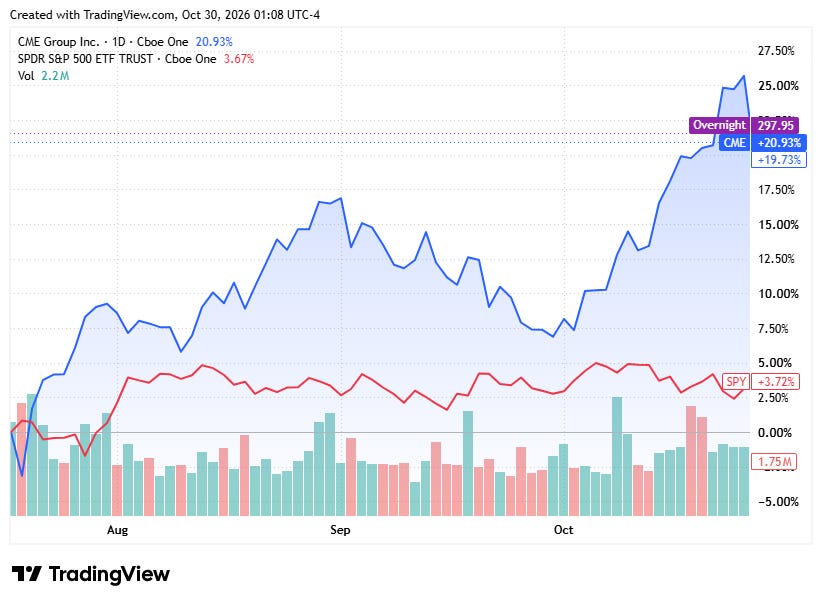
Investors that acted on our research got a fundamentally healthy company that pays an impressive dividend at a depressed valuation.
Earlier this year, we read work from various FinStack writers that DOCU 0.00%↑ ‘s moat as it relates to AI as deceptively strong. With the stock trading in the low to mid forties. The thesis was also just as simple: at a high level, you’d assume there is nothing stopping anyone from slop coding a digital signature app. But the moat is not the app, or the signatures. The moat is their legal framework and infrastructure that makes those signatures enforceable. The narrative faded and DocuSign is now trading at $81 a share.
Quality companies are trading on largely baseless fear driven discounts, but these opportunities are starting to dry-up. As the AI trade is starting to show signs of winding down, capital will start to rotate back into depressed sectors. And the market is growing up to realize that the AI paranoia was nothing more than a monster in the closet. Now more than ever you have a chance to buy quality moats at depressed valuations.
We believe a setup like this is happening right now with Verisk Analytics (NASDAQ: VRSK 0.00%↑ ) but instead of signatures and futures the moat is decades upon decades of proprietary closed source insurance data; and the stock is on a steep discount.
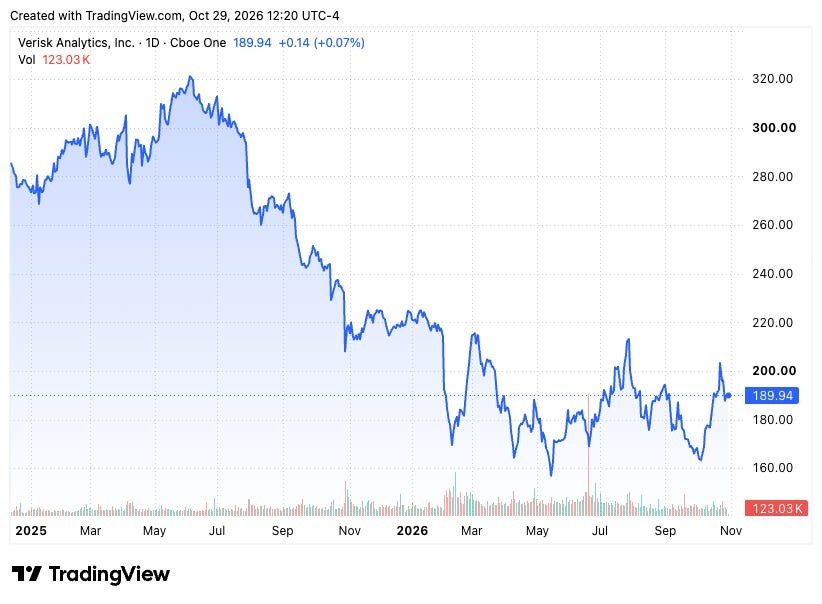
It’s been hammered this year and is down nearly 40% from a peak of $332.92 after AI rumors latched on and merger drama unfolded. It is currently trading at approximately $190 a share.
The first half of this article is FREE to new subscribers with no payment obligation. Subscribe now for access to free institutional grade investment research!
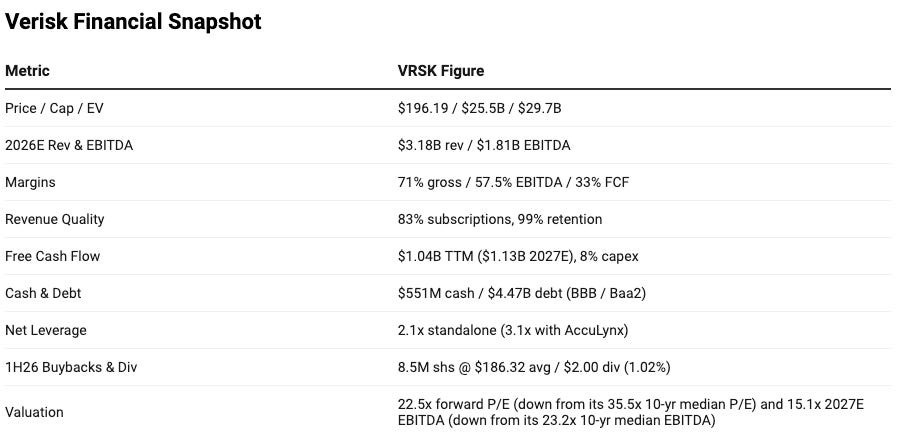
Verisk is the dominant Property & Casualty (P&C) insurance analytical utility, with over 40 petabytes of proprietary data; and it’s trading in a 10 year trough at approximately 15x forward EBITDA because of two primary narratives:
There is a pervasive fear that off the shelf generative AI models, and automated underwriting will either completely bypass Verisk’s proprietary databases or drastically reduce their headcount driven revenue base. We found there are regulatory tailwinds which counteract this narrative as well as growing regulatory discontent and friction for AI insurance startups.
Acculynx Merger: Verisk tried to rescind a $2.35 billion merger with the company; after various regulatory delays. Acculynx sued, and won in court and now Verisk must honor the agreement while regulators finish their review.
We conduct long/short research and call companies how we see them, we are not blindly bullish, or bearish. As such, we investigated the layers of Verisk’s revenue stack for their true exposure to the AI threat. While they are not completely immune to AI, we have discounted the pieces in our final valuation and price target accordingly. Not withstanding, we found a regulatory fortress that we believe is egregiously mispriced at the market’s current valuation.
Company Overview
Verisk is the closest thing to Webster’s dictionary for the U.S. insurance industry and functions much like a brain and central nervous system. They generate approximately 70%+ gross margins and 57%+ EBITDA margins across two divisions.
Underwriting: (70% of revenue): Verisks runs a closed loop database which is powered by over 40 petabytes (40,000+ terabytes) of proprietary insurance data, with over 39 billion in statistical premium/loss records and almost 2 billion historical claims (growing approximately 187,000+ claim records a day.) This is the center of gravity of their moat, and incredibly hard to displace. Nearly every insurer uploads records into Verisk. In exchange, Verisk provides standardized policy forms, models, and actuarial loss/cost tables. This data is closed source and entirely proprietary to Verisk. It is not public internet facing and can not be scraped by large language model web crawlers. Lastly, insurers must submit these tables to all 50 state insurance commissioners in order to get rate increases approved.
Claims: Verisk owns and operates property estimate software called “Xactimate” which tracks real time lumber, shingle, and labor costs down to the zip code so claims settle expeditiously without costly litigation by either party. This is also the gold standard software used by insurers to track, investigate, and dismantle organized insurance fraud rings.
Sell Side Capitulation
Sell side price targets do not predict stock prices; stock prices dictate sell-side price targets. For almost the entirety of 2026 the sell side happily maintained $248-$275 targets on Verisk. Only after shares slid into the trough did they begin revising their targets. Without fully testing the narrative (much as they did with the CME perp narrative.)
Sell siders even admitted in their own notes that AI disruption fears are largely “priced in” with “little evidence of AI-Related disruption thus far.” But not before trimming their price targets by $30 dollars so they wouldn’t stray too far from the street consensus.
Regulatory Tailwinds
We are not looking to completely discredit the legitimate argument that AI may attack certain pockets of Verisk. What we’ve found, however, is a trend of state regulators cracking down on generative AI use in insurance (this actually solidifies Verisk’s moat as it forces insurers to use their proprietary industry recognized data.)
Ahead of earnings on November 5th we believe the street is not adequately modeling Verisk’s headline revenue growth, all while panicking over the merger court ruling (which puts a floor under the stock, oddly enough.) We’ve distilled, separated, and broken down the narratives on the street that are influencing Verisk’s stock, and, what we believe unlocks upside from its current valuation.
Behind the paywall: AI narratives tested, heads I win, tails you lose Acculynx merger, and our 12–18 month re-rating based price target with a conservative and realistic AI handicap applied.
Join the ranks of hundreds of readers who’ve found alpha based on our research this year!
